
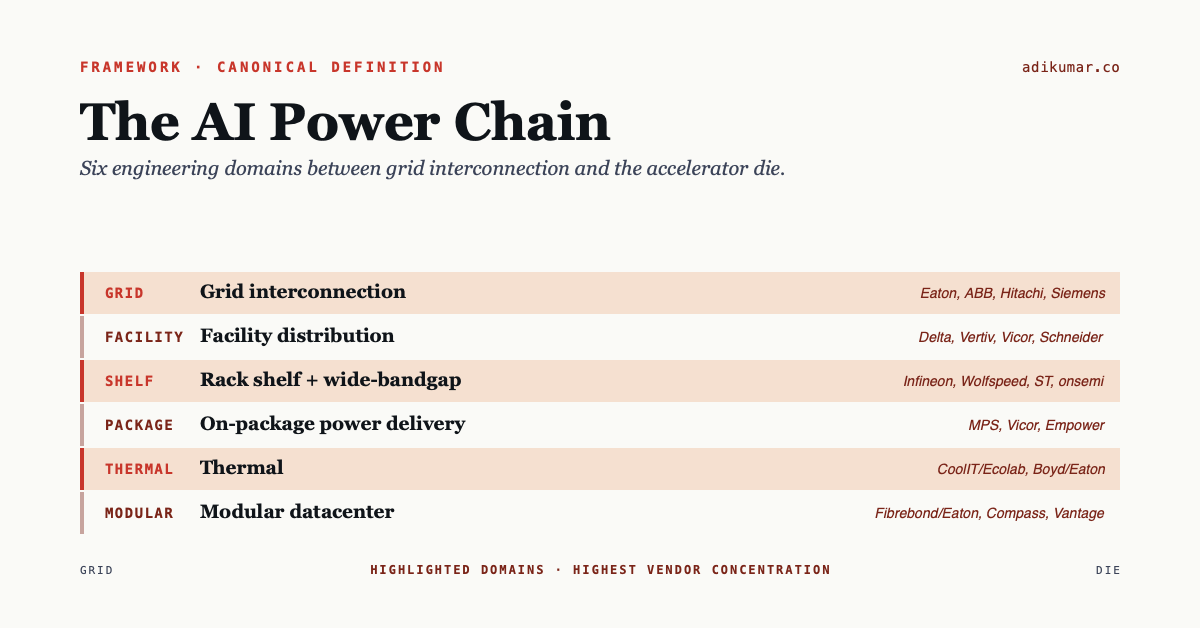
The AI Power Chain framework
Six engineering domains between grid interconnection and the accelerator die. What the framework decomposes, why it exists, how each domain maps to vendor concentration, and where the framework has been applied across the corpus.
The framework in one paragraph
The AI Power Chain runs from the utility service territory boundary to the point-of-load conversion at the GPU or accelerator die. The six intermediate domains cover grid interconnection, facility distribution, rack-shelf rectification and wide-bandgap conversion, on-package power delivery, thermal management, and modular build. Vendor concentration, supply-chain lead times, standards trajectory and qualification cycles all vary across them; none is predictable from the others. Sponsors, operators and hyperscaler strategy teams that treat the six as one commodity input systematically under-price recovery risk in specific domains and over-invest in others.
Why the framework exists
AI infrastructure discussion tends to collapse around three visible actors: chip companies, hyperscalers, and data centre operators. The physical infrastructure between the grid meter and the accelerator package runs invisibly under those three, treated as commodity input.
That treatment held when rack power sat below 30 kW and facility distribution standardised on 415V AC. It has stopped holding as rack power crossed 100 kW during the 2024-2025 GB200 NVL72 deployments, and as facility distribution began to fragment between legacy 415V AC, the OCP sidecar architecture (Mt. Diablo v0.7.0, with a default ±400V bipolar output and a permitted 800V unipolar option), and the native MVAC-to-800V VDC architecture on the Nvidia Blackwell and Rubin reference platforms and OCP's longer-term facility path. At that point the invisible infrastructure becomes a set of six distinct engineering problems, each with its own vendor set, its own qualification cycle, and its own lead-time exposure. The vendor consolidation at thermal management (Eaton acquiring Boyd Thermal in March 2026 for approximately $9.5B per company disclosures, plus Ecolab acquired CoolIT from KKR for approximately $4.75B (closed 2 July 2026) per Ecolab disclosures) is being priced by strategic buyers who already read the market this way. Independent sponsors and asset-level equity holders are largely still pricing the domains as commodity.
The framework applies the same analytical tradition as classical value-chain decomposition in industrial-tech investing, updated for the specific supply-chain, thermal and standards constraints of accelerator-dense compute above 100 kW per rack. It was first developed for internal use during commercial + technical DD workstreams in 2024-2025 and codified in the architecture map essay in early 2026.
The six domains
Grid interconnection
Starts at the utility service territory boundary. Ends at the 34.5 kV or 132 kV medium-voltage bus inside the site substation. Scope covers transformer sizing, switchgear topology, MV cable ampacity, interconnection queue navigation and utility contracting. Generation is currently treated as part of the grid-access problem when behind-the-meter capacity substitutes for utility interconnection; a separate generation domain remains an open framework question addressed in the evolution section below.
Engineering constraint
Large power transformer lead times for high-capacity units reached up to four years by mid-2026 per PwC and Wood Mackenzie analysis, with Hitachi Energy disclosing wait times above 30 months and its CEO citing up to 40 months for the largest units. Siemens Energy Grid Technologies backlog crossed €51B in Q3 FY26 on the same demand. The binding constraint runs through generator step-up units and substation transformers in the MV/HV classes. FERC-regulated ISO interconnection queues run multi-year in most territories. Substation build-out schedules are the binding constraint on gigawatt-scale AI infrastructure siting. Hyperscaler behind-the-meter power procurement (gas turbine, fuel cell, small modular reactor) has moved past the one-off-deal phase into a systematic strategy for side-stepping utility interconnection queues.
Vendor concentration
High and consolidating. Eaton closed Fibrebond in 2024 for approximately $1.4B, Ultra PCS in 2025 for approximately $1.55B, and Boyd Thermal in March 2026 for approximately $9.5B, all per company disclosures and all inside a 24-month window. ABB, Hitachi Energy, Siemens and Schneider hold the balance of the medium-voltage switchgear and transformer stack. Prysmian and Nexans dominate underground MV cable. Fibrebond and Compass ship pre-integrated substation skids.
Standards
IEEE and IEC-mature at the equipment level. AI-specific interconnection patterns (behind-the-meter generation, multi-tenant hyperscaler campuses, hyperscaler-nuclear PPA structures) are still being negotiated case-by-case with no standardised template yet emerging.
Related work
Facility distribution
Starts at the MV bus inside the site substation. Ends at the rack input. Scope covers the low-voltage distribution architecture (415V AC, sidecar 800V DC with configurable output, native 800V DC), the associated switchgear and protection, and the facility-wide backup and ride-through design.
Engineering constraint
This is the domain currently in architectural flux. The 415V AC-UPS architecture that carried the industry through the pre-AI era does not efficiently distribute the 100-500 kW/rack power density that GB200 NVL72 and forward-generation platforms require. Two 800V DC deployment architectures are emerging alongside the incumbent 415V AC. The sidecar architecture (OCP Mt. Diablo v0.7.0, with a default ±400V bipolar output and a permitted 800V unipolar option) converts existing 480 VAC beside the compute racks. The native architecture (Nvidia reference and OCP's longer-term MVAC-to-800V VDC path) moves conversion upstream to the facility perimeter. Both paths are being coordinated inside the OCP 800VDC subcommittee (August 2026), with common interfaces and system requirements rather than one prescriptive topology. Sponsors underwriting hyperscale campuses in 2026 are choosing between the sidecar for retrofit, the native path for greenfield, or committing to 415V AC for the remaining life of the incumbent equipment.
Vendor concentration
Concentrating around the 800V DC transition. Delta Electronics, Vicor, Vertiv and Schneider hold design-in wins on the OCP sidecar path (Mt. Diablo v0.7.0). Vendor design-ins on the native 800V DC path are similarly concentrated across the same set. Legacy 415V AC-UPS vendors (Eaton, Vertiv, Schneider, ABB) retain the retrofit market for the pre-AI installed base.
Standards
In active development. OCP Mt. Diablo v0.7.0 published March 2026. Nvidia 800V DC production specification live for Blackwell and Rubin. In August 2026 Google, Microsoft and Nvidia jointly initiated the OCP MVAC-to-800V VDC workstream, bringing the sidecar and native paths under common interfaces and system requirements. IEC and IEEE working groups are running catch-up on unified standards, with practical convergence unlikely before 2028-2029.
Related work
Rack shelf and wide-bandgap conversion
Starts at the rack input. Ends at the 12V or 48V rack bus that feeds the accelerator boards. Scope covers the rectification stage, the bulk capacitance for pulsed load ride-through, and the wide-bandgap semiconductor content that makes efficient high-voltage-to-low-voltage conversion possible at rack density.
Engineering constraint
The 800V DC facility transition compounds silicon-carbide MOSFET demand at the 1200V voltage class because rectification stages need higher blocking voltage than the incumbent 650V silicon. GaN HEMTs address the higher-frequency point-of-load conversion segments below 100V. The rack shelf itself is where the wide-bandgap adoption curve is currently steepest, and where the qualification cycles for hyperscaler platforms are longest.
Vendor concentration
The merchant SiC market is highly concentrated. STMicroelectronics, onsemi, Infineon, Wolfspeed and ROHM together account for the large majority of merchant SiC power device revenue. Per TrendForce 2023 data, the top five held approximately 91.9% of merchant revenue; Yole 2025 coverage reflects the same top-five leadership. Individual vendor shares for 2025-2026 remain unreconciled at company-disclosure level. Wolfspeed emerged from 2025 restructuring with SiC wafer and device capacity at Mohawk Valley and JP1 online; commercial revenue through the AI-DC layers is still ramping rather than at run-rate, and the utilisation curve is the practitioner-relevant metric. Infineon's $830M acquisition of GaN Systems (October 2023) consolidated the merchant GaN HEMT stack around Infineon, Navitas, EPC and Innoscience. Power Integrations remains merchant on the boundary between silicon and wide-bandgap.
Standards
Silicon-carbide qualification is mature at the device level under JEDEC and AEC-Q101 for automotive-adjacent applications. Data-centre-specific qualification is being negotiated bilaterally between hyperscalers and merchant vendors on multi-year cycles.
Related work
On-package power delivery
Starts at the 12V or 48V rack bus. Ends at the 0.8V rail feeding the accelerator die. Scope covers the multi-phase point-of-load converter topology, the on-package (or vertical) placement of the converters, the on-die decoupling capacitance, and the backside power delivery network topology when present.
Engineering constraint
An 800W GPU package at 0.8V draws 1,000 amps. A 2,250W package draws 2,800 amps. Copper interconnect physics constrain how much of that current can flow through package substrate before ohmic loss becomes the dominant efficiency term. Vertical power delivery and backside power delivery network are the two architectural responses. Both require converter topology and packaging co-design that narrow the pool of merchant vendors capable of hyperscaler-scale qualification.
Vendor concentration
Concentrated. Monolithic Power Systems has the deepest disclosed merchant footprint on hyperscaler point-of-load design-ins for point-of-load converters. Vicor holds the vertical-power position with its factorised architecture and lateral-topology variants. Analog Devices (following its July 2026 acquisition of Empower Semiconductor for $1.5B) holds the integrated-IVR position on specific accelerator platforms. Analog Devices and Texas Instruments retain merchant share on the boundary with board-level multi-phase.
Standards
Little formal standards activity. The interfaces are proprietary to accelerator platforms. Merchant vendors compete on qualified reference designs and per-platform integration engineering rather than on common standards.
Related work
Thermal management
Starts at the accelerator die-attach layer where heat is generated. Ends at the facility rejection layer where heat leaves the site. Scope covers cold-plate design, coolant chemistry, coolant distribution unit (CDU) architecture, secondary-loop separation, and the choice between direct-to-chip liquid cooling and full-rack immersion.
Engineering constraint
Air cooling becomes increasingly impractical above roughly 100 kW per rack at conventional facility conditions, pushing high-density AI deployments toward liquid cooling. Direct-to-chip liquid cooling with single-phase coolant is becoming the default for AI training racks in the 100 to 400 kW/rack range. Two-phase immersion is positioned as a candidate architecture for extending the density envelope beyond ~500 kW/rack in Rubin Ultra and custom-silicon workloads; specific per-platform thresholds remain vendor-disclosed rather than universal. Both boundaries are architecture-, workload- and facility-dependent rather than universal industry thresholds. Coolant chemistry sourcing, CDU architecture qualification, and multi-year approval cycles for hyperscaler-qualified quick-disconnects are the current supply-side chokepoints.
Vendor concentration
Reshaping through 2024-2026 M&A. CoolIT held the largest merchant share of hyperscaler DLC design-in wins pre-acquisition; Ecolab acquired CoolIT out of KKR for approximately $4.75B (closed 2 July 2026). Schneider Electric acquired a 75% controlling interest in Motivair in February 2025 for $850M, with the remaining 25% subject to a 2028 put/call arrangement. Boyd Thermal was acquired by Eaton for approximately $9.5B (closed 12 March 2026). Trane Technologies acquired LiquidStack (closed 3 March 2026), directly extending Trane's DTC-to-immersion coverage. Vertiv built cooling capability through capability tuck-ins including Strategic Thermal Labs and PurgeRite rather than through a headline DLC acquisition.
Standards
OCP Sustainability Project drove quick-disconnect and cold-plate interface standardisation across 2024-2026. Coolant chemistry (particularly PFAS-based dielectrics used in two-phase immersion) is subject to active regulatory pressure in the EU and California.
Related work
Modular datacenter
Starts at the facility building envelope. Ends at the site perimeter fence. Scope covers prefabricated power skids, cooling modules, structural enclosures, and the on-site assembly process that turns factory-built components into a commissioned data centre. This domain is a delivery scope rather than another electrical or thermal conversion stage; the economic story runs through manufacturing scale and site cycle time, not conversion efficiency.
Engineering constraint
The dominant constraint on hyperscale AI capacity today comes from the qualified craft-labour base of medium-voltage electricians, industrial mechanical contractors, and switchgear commissioning specialists available to build gigawatt-scale sites on a two-year cycle. For a growing share of 2027-2028 hyperscale build schedules, the craft-labour bottleneck is becoming a binding constraint alongside chip supply rather than a downstream consequence of it. Our estimate, combining US Bureau of Labor Statistics electrical-occupation data with announced hyperscale construction requirements, points to a potential two-to-three-times skilled-labour gap against 2028 build cadence. This is an author-constructed inference from the BLS series cross-referenced with hyperscaler build disclosures, not a published BLS figure. Our engineering estimate is that modular prefab reduces the on-site labour requirement per gigawatt of installed capacity by roughly two to three times against fully stick-built equivalents. That reduction is the primary economic case for the domain.
Vendor concentration
Growing. Fibrebond (Eaton) ships pre-integrated power skids at scale. Compass Datacenters and Vantage ship prefabricated buildings and cooling modules. Vertiv, Delta, Schneider and specialist integrators ship modular power and cooling components. The hyperscaler-captive stack (Microsoft's Ballard-adjacent capacity, Meta's internal modular teams) is a growing share of the total buildout.
Standards
Limited standardisation across vendors. Interface specifications for water, power and control connections at the skid boundary are the leading engineering constraint on multi-vendor commissioning and drive the qualification cycles.
Related work
Framework calibration
Case studies apply the physical scorecard alongside the Investment Layer verdict on 2024-2026 transactions. Each transaction stresses different domains of the framework, which is the practical test of whether the six-domain decomposition survives contact with real deals.
- AirTrunk / Blackstone + CPP (Sep 2024). Per-domain scores put physical at ~22% (LOW-MEDIUM band). The clean-asset calibration anchor; low physical concentration across all six domains.
- Crusoe / Stargate Abilene. Physical HIGH on grid interconnection (behind-the-meter gas) and rack shelf (single-accelerator SiC concentration). The framework's grid-and-generation scenario, materialised.
- CoreWeave DDTL 3.0. Portfolio-averaged physical MEDIUM. Compute delivered from colocation footprint rather than greenfield; the debt-facility calibration path.
What the framework tells you
The framework produces three analytical claims that individual essays develop in depth. The current Vendor Screen indicates vendor concentration is highest at grid interconnection, rack shelf (wide-bandgap) and thermal management, and lowest at modular build. Value capture concentrates unevenly across the six domains, which the operator-level narrative that treats them as commodity fails to price.
Lead-time exposure is highest at grid interconnection (200+ week transformer lead times) and thermal management (multi-year qualification cycles for coolant chemistry and quick-disconnects). Rack shelf and on-package delivery have supply-side capacity growing on a two-to-four year investment cycle. Facility distribution lead-time exposure is currently short but concentrating around the 800V DC transition. Modular build lead-time exposure is driven by skilled-labour availability rather than equipment supply.
Standards fragmentation is highest at facility distribution, where 415V AC, sidecar 800V DC and native 800V DC architectures coexist, at on-package delivery (proprietary per-accelerator interfaces), and at modular build (limited multi-vendor interface standards). Sponsors and operators making architectural decisions in fragmented domains commit to specific vendor stacks for the useful life of the equipment, and the cost of choosing wrong compounds over the full asset life.
The AI Power Chain Vendor Screen scores 300+ vendors across the six domains on moat, chokepoint, AI exposure and execution. The scoring is the operational output of the framework applied to the vendor universe.
What the framework does not do
The framework decomposes the physical infrastructure into six engineering domains. It surfaces where value concentrates and where lead-time and standards risks compound. Asset-level, domain-specific financial modelling requires separate machinery and belongs in the Investment Layer essays.
The framework is a snapshot of the physical infrastructure architecture as of August 2026. It covers physical infrastructure only. Software above the accelerator, model-training economics that drive accelerator demand, and customer-side capacity procurement decisions belong to adjacent frameworks that were developed and applied separately.
The framework treats the six as sequential in the physical power path but not necessarily sequential in the operator or sponsor analytical process. Real DD workstreams cover the six in parallel with heavy interaction between facility distribution and thermal management, and between grid interconnection and modular build. The numbering follows physical scope. Analytical priority is separate.
Where the framework has been applied
The framework structures the analytical content across the AI Power Chain series, the Investment Layer series, the Due Diligence for the AI Buildout series, and the DC-DC Transition series. The three cross-cutting essays inside the AI Power Chain series explicitly work across all six layers:
- The AI Power Chain Vendor Screen, 300+ vendors scored across all six domains
- Pricing Under Scarcity, where premium capture is compounding across the domains
- The Services Inversion, where services multiples are converging with product multiples across the domains
The Investment Layer series applies the framework to capital allocation decisions:
- The AI infrastructure M&A map, 2023-2026 transaction pattern mapped to the six domains
- The PE playbook, layer by layer, sponsor economics by domain
- Underwriting AI infrastructure debt, recovery risk by domain
The Due Diligence for the AI Buildout series operationalises the framework across sixteen DD workstreams, with several workstreams (product architecture and technology DD, manufacturing, IP and supply chain DD) explicitly organised by domain.
Framework evolution
Three open questions currently shape how the framework will evolve through 2027-2028. Each will be revisited as the underlying market data resolves.
The facility-distribution architecture question resolves as the OCP-standardised interfaces are adopted across both the sidecar (Mt. Diablo, with configurable bipolar or unipolar output) and the native MVAC-to-800V VDC path. The durable split is retrofit vs greenfield rather than vendor vs vendor. Rack shelf and on-package delivery vendor concentration follow the facility-distribution outcome with a two-to-three year lag.
The thermal-versus-modular boundary is dissolving as thermal capacity is increasingly integrated into modular prefab skids at the vendor level (Boyd/Eaton, Motivair/Schneider). Whether the two remain analytically separable at the framework level is an open question and will be revisited if the operational integration compounds.
The grid-versus-facility boundary is also under pressure as behind-the-meter power procurement (nuclear PPAs, on-site generation, hyperscaler-utility JVs) transitions from one-off transaction into repeatable strategy. The framework may absorb some of the grid-interconnection scope into a new "generation" domain if the pattern compounds.
Cross-framework note: the Grid-to-Chip companion series completes at P5 · Rack to gate, covering the last conversion cascade from rack input to transistor gate. Adjacent to the rack and point-of-load stages of this AI Power Chain framework.
Essays and supplements applying the AI Power Chain framework
This framework structures physical-infrastructure analysis on adikumar.co. The essays below apply it, calibrate it, or extend it stage by stage.
- 1/13The real reason data centres are going DC (and it's not capacity alone)
- 2/13Two architectures wearing the same name (and how the industry is converging)
- 3/13The architecture map (where every stage lives, who builds it, what's standardized)
- 4/13Arc behaviour, protection, and how insurance is catching up
- 5/13Grounding, bonding, and DC ground-fault protection at 800 VDC
- 6/13Battery integration at 800 VDC: UPS restructured, not replaced
- 7/13Retrofit versus greenfield: the DC-DC decision framework
- 8/13800 VDC and liquid cooling: co-emerging, not independent
- 9/13Power quality, harmonics, and grid interaction at 800 VDC
- 10/13Standards evolution: OCP, IEC, NEC, IEEE, and the 2028-2029 convergence
- 11/13Vendor economics: who wins the 800 VDC transition
- 12/13Commissioning, skills, and operational readiness at 800 VDC
- 13/13The ten-year view: where 800 VDC data centres land by 2028, 2030, and 2035 (series close)
- AThe Transition Tax: where the 800V DC capex premium lives
- BHybrid Forever: why most large AI-oriented facilities will run mixed AC/DC through 2035+
- CThe Voltage Ceiling: 1500V DC and the MVDC question
- DThe Solid-State Transformer: perimeter-conversion supplier dynamics
- EThe Sidecar Power Rack and the OCP-spec ecosystem
- FThe Connector Wars: rack-to-rack interface engineering (series close)
- P1Electrons: firm generation for the AI campus
- P2Grid Access: connection rights, regulatory regimes and the transmission side
- P3Campus Power: MV distribution, SSTs and the power-transformer bottleneck
- P4Hall Power: the relocation of the power-conversion boundary
- P5Rack to Gate: SiC, GaN, POL and the last conversion cascade
- The modular datacenter stack · technical companion
- The on-package delivery stack · technical companion
- The interconnect stack · technical companion
- The thermal stack · technical companion
- The wide-bandgap stack · technical companion
- The capacitor stack (800 VDC) · technical companion
The IVR Stack: The Final Bottleneck in AI Accelerator Power Delivery
The technical companion below the On-Package Delivery Stack market essay. Establishes the canonical architecture taxonomy for integrated voltage regulators (Board VRM, VPD, PIVR, SIVR, on-die IVR), the four physical constraints that force conversion toward the die, the two-stage 48V or 800V to core rail PDN, the Empower / Ferric technical fork, the $1.5B ADI-Empower acquisition anchor, and the Marvell test as the first observable merchant IVR battleground.