
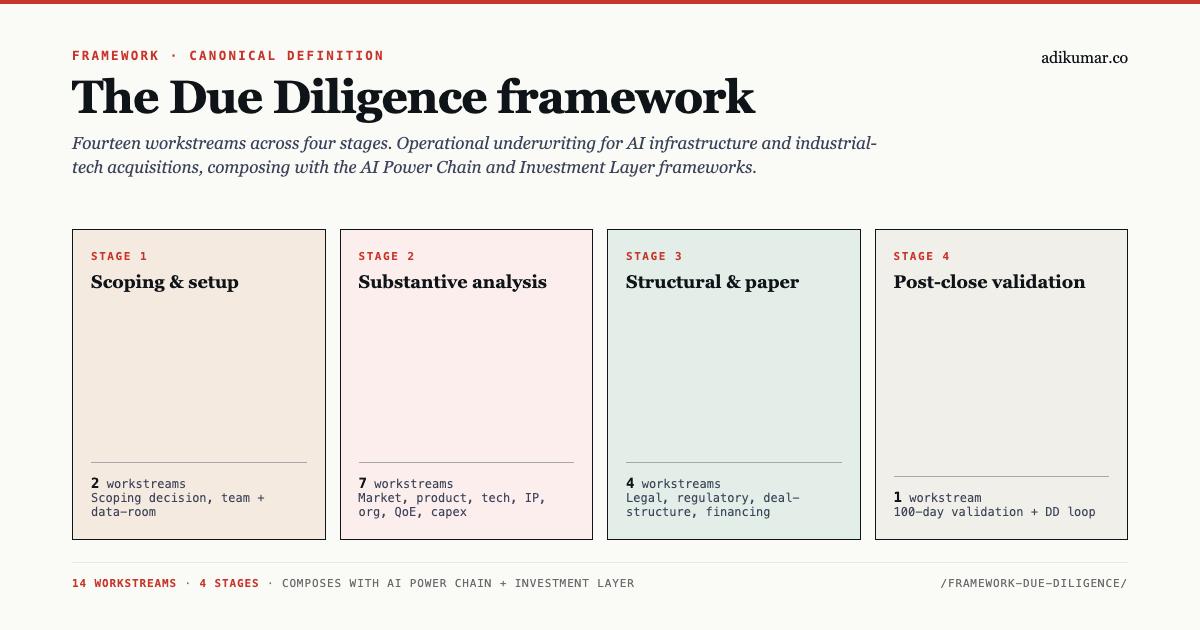
The Due Diligence framework
The workstream commercial and technical due diligence framework for AI infrastructure acquisitions, organized across four stages, with the companion reference assets. The operational layer that sits alongside the AI Power Chain framework (physical) and the Investment Layer framework (capital allocation).
AirTrunk / Blackstone + CPP · UNDERWRITE benchmark. Clean physical, clean thesis, GREEN veto.
CoreWeave $2.6bn DDTL · AMBER worked example. Uncontracted principal absorbed by parent-guarantee recourse.
Crusoe / Stargate Abilene · RESTRUCTURE + realised-prediction. Concentration risk flagged pre-close, materialised at month fifteen.
Not a checklist. A dependency graph. A finding at WS03 changes what you ask at WS04. A finding at WS05 changes the capex model at WS08. A finding at WS10 changes the escrow at WS12. Every workstream feeds the next. Every finding lands in the transaction structure or the financing.
WS01 What must be true, and what would falsify it?
WS02 Can we execute the tests with signal, not noise?
WS03 Is the demand real?
WS04 Can the target capture the demand, at what price, against whom?
WS05 Will the technology become revenue?
WS06 Can it actually be made, protected, and supplied?
WS07 Are the reported earnings the economic truth?
WS08 What must be true for the price to work?
WS09 Can the organisation execute it?
WS10 Can the contracts support it?
WS11 Can the regulatory environment support it?
WS12 Who bears the residual risk?
WS13 Can the transaction be financed?
WS14 How do we know after close whether we were right?
Question Banks How do we actually test each finding?
Seller-side prep What evidence should the target have ready before the process opens?
DD Evidence Matrix How does each finding trace from question to transaction consequence?
Each workstream is one question. Every finding lands as an update to one or more of the questions downstream. WS12 is the pivot: it is where every prior workstream’s finding gets allocated to price, structure, escrow, condition precedent, or walk.
The framework in one paragraph
Every AI infrastructure acquisition should be screened against the same workstreams, with depth varying by target and transaction. Standard checklists from generalist DD firms cover the classical shape of these workstreams but miss the AI-specific dynamics: hyperscaler-contract debt structures that concentrate recovery risk at the counterparty rather than the operator, thermal supply chain qualification cycles that gate hyperscaler production timing, wide-bandgap semiconductor design-in windows that determine profit-pool distribution across the AI Power Chain. The workstream framework maps how those AI-specific dynamics fall inside each classical workstream, and how the workstreams interact across four DD stages from pre-data-room scoping to post-close validation.
The workstreams operate as a dependency graph
The workstreams are not 14 independent checklists. Findings in any single workstream change the questions, depth and decision thresholds in others. The framework therefore sequences DD by dependency rather than treating every workstream as parallel.
Some worked examples of the dependency chains that recur across live transactions. Findings from Workstream 03 (market and demand) reshape the questions asked in Workstream 04 (customer, pricing, competitive). Findings from Workstream 07 (quality of earnings) and Workstream 08 (capex, growth economics, stress-testing) both feed the debt sizing and covenant selection in Workstream 13 (financing structure). Findings from Workstream 05 (product architecture and technology) reshape the manufacturing capacity questions in Workstream 06 and can feed reps and warranties carve-outs in Workstream 12. A 16-week slip in transformer or CDU lead times identified inside Workstream 05 or 06 does not sit as an operational footnote, it triggers liquidated damages modelling in Workstream 08 and MAC-clause negotiation in Workstream 13.
| Workstream | Feeds into | Fed by |
|---|---|---|
| WS 01 Scoping decision | WS 02, WS 14 (baseline for validation) | WS 14 (prior-deal retrospective) |
| WS 02 Team, timeline, data room | WS 03-14 (execution) | WS 01 |
| WS 03 Market and demand-side DD | WS 04, 08, WS 11 (via power sub-workstream) | WS 01, 02 |
| WS 04 Customer, pricing, competitive DD | WS 07, 08, 12 | WS 03 |
| WS 05 Product architecture and technology | WS 06, 08, 11 (export controls), 12 | WS 02 |
| WS 06 Manufacturing, IP, supply chain | WS 08, 12, 13 | WS 05 |
| WS 07 Quality of earnings + working capital | WS 08, 13 | WS 04 |
| WS 08 Capex, growth, stress-testing | WS 12, 13 | WS 03, 04, 05, 06, 07 |
| WS 09 Organisational, personnel, systems | WS 12 (retention escrow), 14 (KPIs) | WS 02 |
| WS 10 Legal and contract DD | WS 12, 13 | WS 04, 05 |
| WS 11 Regulatory, CFIUS, environmental | WS 12, 13 (CFIUS closing gate) | WS 03 (power/permitting), 05 (export controls) |
| WS 12 Deal structure, R&W, escrow | WS 13 | WS 04, 05, 06, 08, 09, 10, 11 |
| WS 13 Financing, covenants, closing risk | WS 14 (covenant thresholds) | WS 07, 08, 11, 12 |
| WS 14 Post-close validation + loop | WS 01 on next deal (feedback loop) | WS 09, 13, all substantive WS (via falsification observables) |
Reading the table: findings in the "fed by" column reshape the questions, depth or decision thresholds for the row workstream. Findings in the row workstream reshape the same for the "feeds into" column. Reverse-lookups are supported. If a finding surfaces in Workstream 06 (manufacturing or supply chain), the "feeds into" row shows that WS 08 capex modelling, WS 12 R&W carve-outs and WS 13 financing MAC clauses all need to be re-scoped against that finding before Stage 3 closes.
The practical implication is that DD sequencing follows the dependency graph rather than the linear list order. Substantive workstreams that produce findings that reshape structural workstreams get run first with heavier weight. Workstreams whose output feeds another workstream's depth calibration get run at appropriate depth before the downstream workstream is scoped. Running the workstreams strictly in parallel with equal depth misses the compounding value that comes from dependency-aware sequencing.
Depth allocation across the workstreams
Scoping determines which of the workstreams get deep analytical treatment and which get lighter coverage. The framework carries three explicit depth tiers, set at scoping and adjusted through the diligence as findings emerge.
Screen tier
Standard checklist coverage against known category risks. Depth calibrated to the sponsor's minimum-acceptable-diligence bar for the asset class. Typical time allocation is 5-15 percent of workstream budget. Used when the workstream area is well-understood for the target class and the underwriting does not turn on findings in this workstream.
Standard tier
Full workstream coverage with expected-depth analytical work on the classical questions and AI-infrastructure-specific sub-workstreams where applicable. Typical time allocation is 15-40 percent of workstream budget. Default depth for most substantive workstreams on most transactions.
Deep tier
Expanded coverage with bench-work, specialist advisor engagement, external technical verification and structured stress-testing. Typical time allocation is 40 percent or more of workstream budget. Reserved for workstreams where the underwriting turns on findings, and where the evidence quality going in is noisy enough to justify the additional cost.
Depth allocation combines five scoping inputs: materiality (how much a finding in this workstream could move the underwriting), uncertainty (how noisy the available evidence is going into diligence), reversibility (whether a finding can be corrected post-close, or locks in for the asset life), and thesis sensitivity (whether the workstream directly tests a load-bearing assumption in the deal thesis), and decision proximity (how urgently the finding must land relative to the next transaction milestone: signing, closing, financing, or a specific post-close date). Screen tier is appropriate when all five factors are low. Deep tier is appropriate when any single factor is high enough to change the go or no-go decision.
Depth allocation is a Workstream 01 output and is re-scoped through Stage 2 as findings emerge. A screen-tier workstream that surfaces an unexpected material finding gets re-scoped to standard or deep tier before the analytical work continues. A deep-tier workstream that clears cleanly in the first analytical pass gets stepped down for the remainder. Scoping is a rolling calibration exercise, not a one-time decision at LOI.
Why the framework exists
Standard commercial and technical DD frameworks in industrial-tech investing were shaped by two decades of transactions in industrial technology, specialty semiconductors, and process automation. Those frameworks translate loosely onto AI infrastructure targets but miss the specific supply-chain, financial-structure, and regulatory dynamics that decide recovery risk under stress.
Three examples of the gap. Standard quality-of-earnings analysis on a specialist GPU cloud operator will treat DDTL debt as corporate credit and miss the counterparty-concentration structure. Standard technical DD on a wide-bandgap semiconductor target will assess product margin without decomposing the hyperscaler qualification cycle that determines whether design-in wins land. Standard regulatory DD on a data centre developer will map CFIUS and environmental permitting without accounting for grid interconnection queue positioning as the binding constraint on site value.
The framework was developed during 2024-2025 DD work on AI infrastructure targets across power electronics, thermal management, and GPU cloud operators. It codifies the workstream approach the DD team applied on those live transactions and organises them into four DD stages that follow the actual sequence of the diligence process from LOI through post-close. The Due Diligence for the AI Buildout series covers each workstream in depth.
The four DD stages
Stage 1. Scope and setup
the workstreams that happen before the data room opens. Most of what determines whether DD creates or destroys value happens here, well before the substantive analytical work starts.
Workstream 01. The scoping decision
What to examine, at what depth, against what walk-away criteria, with what pre-committed authority. Scoping determines which of the substantive workstreams get deep analytical treatment and which get lighter checklist coverage. Under-scoping produces missed issues at close. Over-scoping burns budget on workstreams that do not move the underwriting.
Workstream 02. Team, timeline, and the anatomy of a data room
Team composition, workstream sequencing, and data-room engagement. Scoping decides what to test. Execution decides whether tests get run with signal or noise. Team fit to the specific AI-infrastructure sub-sector is where this workstream compounds value across deals.
Related work
Stage 2. Substantive workstreams
The seven analytical workstreams that test whether the deal thesis holds against operating reality. These run in parallel with heavy inter-workstream dependencies. Findings from any single workstream typically feed the framing of two or three others.
Workstream 03. Market and demand-side DD
Tests whether the demand the target sells into is what the CIM describes. Bottom-up TAM construction from customer specifications, growth vintage decomposition to separate structural growth from pull-forward cycles, and cyclicality benchmarking against comparable industrial sub-sectors.
Named sub-workstream: power procurement and interconnection. The most operationally binding constraint on AI infrastructure targets cuts across three classical workstreams (this one for market demand, Workstream 08 for the capex and PPA economics, Workstream 11 for the regulatory permitting) and typically gets lost between them. The framework carries an explicit named sub-workstream here for power procurement and grid interconnection: firm versus non-firm transmission rights, ISO queue positioning, curtailment formulas, utility tariff rate escalation riders, and PPA counterparty credit. Cross-references to Layer 1 of the AI Power Chain framework for the physical interconnect vendor stack.
Workstream 04. Customer, pricing, and competitive DD
Tests what the target actually captures from the demand base identified in Workstream 03. Concentration decomposition, pricing power diagnosis, and twelve-month competitive move tracking. A concentrated customer base that looks stable today can be losing share to a competitor whose moves the twelve-month tracker would catch.
Workstream 05. Product architecture and technology DD
Runs as three parallel tests. The current product tested against the specifications the market actually pays for. The roadmap credibility tested by evidence tier (working prototypes vs bench data vs slideware). The differentiation audit tested against customer decision thresholds. For AI infrastructure targets, bench-work priorities vary sharply by AI Power Chain layer.
Named sub-workstream: thermal and high-density power. Above 100 kW per rack, thermal management (fluid loop metallurgy, dielectric compliance, CDU redundancy, coolant chemistry qualification) and high-density power delivery (800V DC switchgear protection, wide-bandgap converter qualification cycles) become primary failure modes at Stage 2, ahead of secondary product-architecture attributes. The framework treats these as a named sub-discipline within Workstream 05 for AI training and inference targets, with explicit reference to Layers 3 through 5 of the AI Power Chain framework.
Workstream 06. Manufacturing, IP, and supply chain DD
Tests the business making the product. Capacity vs demand, yield analysis, IP audit across four categories (patents, trade secrets, licences, freedom-to-operate), and tier-1 plus tier-2 supply-chain audit. Where technical DD tests the product, this workstream tests whether the operational capability behind it holds.
Workstream 07. Quality of earnings and working capital DD
Tests whether reported financials describe the underlying business. Add-back discipline, dynamic working capital modelling, and the OEM balance-sheet financing that CIMs typically under-disclose. Standard QoE work misses the AI-specific structural features around hyperscaler-contract receivables and vendor-financing programmes.
Named sub-workstream: tax DD. Tax-affected earnings adjustments, property-tax abatement durability under change-of-control, sales-and-use tax exemptions on GPU capex, tax-equity structures and investment tax credit (ITC) survival mechanics. For AI infrastructure targets developed under state or local abatement programmes, this sub-workstream materially reshapes the post-tax earnings picture and belongs inside Workstream 07 for that reason.
Workstream 08. Capex, growth economics, and projection stress-testing
Capex per dollar of revenue growth, incremental unit economics compared against average, three downside scenarios stress-tested with compound assumptions, and refinancing risk analysis on 2020-2022 vintage debt as it comes due. Projection stress-testing carries the highest analytical leverage of any workstream at this stage.
Named sub-workstream: construction and completion DD. For development-stage targets, EPC contract terms, milestone conditions precedent, equipment-delivery versus energization dependencies, liquidated damages structures, and completion guarantees all shape the cash flow model directly. A 16-week slip in transformer or CDU lead times identified in Workstream 05 or 06 triggers liquidated damages modelling here and MAC-clause negotiation in Workstream 13. Construction DD sits inside Workstream 08 because its analytical output feeds directly into the capex-per-MW and Year 1-2 levered cash flow projections.
Workstream 09. Organisational, key personnel, culture, and systems DD
Tests whether the target's people, culture, and systems can execute what the other workstreams describe. Where post-close value destruction most often begins, and the workstream that generalist DD firms most consistently under-invest in.
Four concrete tests inside Workstream 09. Decision-rights mapping (who actually decides what, and how many decisions currently route through founder or CEO). Key-person dependency analysis (which two or three people would materially damage delivery if they left within 12 months of close). Systems maturity assessment (whether operational tooling can support the scale the growth projections assume, or whether spreadsheet-to-system transitions are needed pre-close). Integration capacity readiness (whether the target has the operational bandwidth to absorb the acquirer's reporting, controls and integration programme without derailing operating performance).
Related work
Stage 3. Structural and paper
the workstreams that translate analytical findings from Stage 2 into transaction paper, closing conditions and financing structure. These workstreams sit closer to the transaction lawyers and finance leads than to the analytical DD team, but the findings feeding them come from the substantive workstreams.
Workstream 10. Legal and contract DD
Corporate structure, material contracts, change-of-control provisions, non-compete enforceability, IP filings and freedom-to-operate, litigation exposure. Where the analytical deal thesis meets the paper record. For AI infrastructure targets, change-of-control provisions on hyperscaler contracts carry disproportionate weight.
Workstream 11. Regulatory, CFIUS, environmental, cyber DD
Approvals that gate closing, environmental liabilities that follow the asset, cyber posture that determines whether Day-1 integration proceeds cleanly. Four sub-workstream areas that are often treated as discrete specialist workstreams rather than integrated closing and value risks: export controls (particularly for wide-bandgap semiconductor targets and specialist compute), data sovereignty and localisation requirements, foreign ownership screens beyond CFIUS itself (UK NSI, EU FDI, APAC equivalents), grid and permitting approvals as closing gates, and critical infrastructure designation where applicable.
Cross-reference to Workstream 13. CFIUS approval carries closing-condition-precedent weight rather than post-close regulatory risk. Deal structure and financing timelines in Workstream 13 need to accommodate CFIUS review windows explicitly, with drop-dead date mechanics and financing bridge structures that survive extended review. For sovereign co-investment scenarios the interaction becomes more complex and is covered in the Framework Evolution section below.
Workstream 12. Deal structure, reps and warranties, escrow architecture
How DD findings translate into the transaction paper. Structure choice, R&W insurance selection, escrow architecture with DD-informed carve-outs, earnout mechanics. Reps and warranties written without informed carve-outs leave the acquirer exposed to specific risks the substantive workstreams identified.
Workstream 13. Financing structure, covenants, closing risk
How the deal gets paid for, what covenants the financing carries, and what stops closing after signing. Debt sizing against the QoE and capex work from Workstreams 07-08. MAC clauses and refinance stress against the downside scenarios from Workstream 08.
Related work
Stage 4. Post-close validation and DD improvement loop
The final workstream. 100-day validation testing the DD thesis against operating reality, six-month retrospective that feeds the next transaction's scoping. This is where the framework compounds across deals rather than treating each transaction as a standalone exercise.
Workstream 14. Post-close validation and the DD improvement loop
Two-part work. The 100-day validation compares Day-90 operating reality against the target the DD workstreams described on Day 0. The six-month retrospective produces the structured learnings that update the scoping approach on the next deal in the same sub-sector. Sponsors that skip this workstream lose most of the framework's compounding value.
Falsification observables. Each material DD conclusion should carry a post-close observable that can falsify it. A DD conclusion that customer concentration is manageable has renewal, churn, pricing or volume metrics that either bear it out or contradict it. A DD conclusion that capex assumptions are achievable has actual capex per MW or actual capex per dollar of revenue as the falsifier. A DD conclusion that management can execute has hiring pace, delivery milestones and operational KPIs as the observable. Workstream 14 therefore runs less as a retrospective exercise and more as a falsification mechanism for the analytical claims each substantive workstream produced.
Signal-monitoring dashboard. A named component of Workstream 14 is the quantified, owned, trigger-based signal-monitoring dashboard that tracks the post-close observables against the DD claims they were derived from. Each observable has a data source, a named owner in the portfolio company, and a trigger level that flags material deviation from the DD baseline. Portfolio companies that carry this dashboard operationally on Day 100 make the six-month retrospective a structured comparison against pre-set thresholds instead of a reconstruction from memory.
Related work
The companion reference assets
The workstreams compose with the companion reference assets that split responsibility across four product-architecture roles. The framework itself covers what to investigate and why. The Question Banks cover how to test each finding. The Seller-side prep workbook covers what evidence the target should have prepared before the process opens. The DD Evidence Matrix covers how each finding is tracked from question to conclusion, with provenance and owner attached.
The Question Banks. Approximately 250 diligence questions organised by DD workstream and cross-referenced by AI Power Chain layer. The Question Banks are meant to be lifted and adapted for live deals as a starting reference, then refined against the specific target and the specific sub-sector. See The Question Banks.
Seller-side prep workbook. The workstreams inverted for target-side perspective. What a founder, CEO or sell-side team should prepare before the process opens so DD Week 1 is signal-dense rather than an evidence-scramble. See Seller-side prep.
DD Evidence Matrix. A structured tracker mapping each diligence question to the evidence requested, source location, named owner, status, provenance code and finding. Bridges the framework to the actual data room and keeps falsification observables in Workstream 14 traceable to their DD origin. See The DD Evidence Matrix for the full description, the CoreWeave DDTL 3.0 worked example, and the operating protocol.
| WS | Question | Evidence + source | Owner | Prov. | Finding |
|---|---|---|---|---|---|
07 | Are Q4 add-backs recurring or one-off? | Board minutes + audit workpapers FY24-25; data room 5.4 | DD lead (financial) | P | Recurring; underwrote as adjusted EBITDA |
05 | Is the roadmap credibility supported by working prototypes? | Bench walkthrough + third-party test data; site visit day 2 | DD lead (technical) | P | Working prototypes on 3 of 5 roadmap items, slideware on 2 |
08 | Do capex projections survive 16-week transformer slip stress? | Analyst downside model with LD schedules | DD lead (financial) | D | DSCR falls to 1.15 in stress; covenant carve-out negotiated in WS 13 |
11 | Does target have export-control exposure on WBG components? | Legal review of BOM + BIS classifications; specialist counsel | Regulatory specialist | P | Two components require BIS advisory opinion, closing gate |
14 | Post-close: has customer concentration remained within DD range? | Portfolio company monthly customer revenue report | Portfolio CFO | P | Live tracking; day-100 baseline set at 41% top-3 concentration |
Provenance codes follow the P/D/I convention established in the case studies series: P primary evidence directly sourced (SEC filings, audit workpapers, executed contracts, board minutes), D derived from primary evidence through explicit analytical modelling, I illustrative or assumption-based for scenario or sensitivity work. Every DD finding that carries into the IC memo should carry a P or D provenance code. Findings tagged I in the analytical work are treated as pending until upgraded to P or D through additional evidence.
What the framework tells you
The framework produces three analytical claims that individual essays develop in depth.
First, DD value creation concentrates at Stage 1 (scoping) and Stage 4 (post-close validation), well ahead of the visible Stage 2 substantive work. The reasoning is straightforward. Stage 2 analytical output is useful only to the extent that Stage 1 pointed the analytical work at the right questions and Stage 4 tested whether the conclusions held after Day 90. Under-scoped Stage 1 work sends the DD team down analytical paths that do not move the underwriting. Skipped Stage 4 work leaves the sponsor without falsification observables on the analytical claims, so the same category of error recurs on the next deal. Sponsors that under-invest in either bookend systematically over-invest in Stage 2 substantive work without capturing the leverage that would make it worth it.
Second, workstream sequencing follows dependencies rather than the linear list order. Workstream 04 (customer + pricing + competitive) depends on findings from Workstream 03 (market + demand). Workstream 13 (financing structure) depends on findings from Workstreams 07 and 08 (QoE + capex). Running workstreams strictly in parallel misses the compounding value that comes from sequencing them by dependency.
Third, AI-specific dynamics fall inside classical workstream categories in specific ways. DDTL structural credit shows up in Workstreams 07 and 13. Hyperscaler qualification cycles show up in Workstreams 05 and 06. Grid interconnection queue positioning shows up in Workstreams 03 and 11. The framework surfaces where each AI-specific dynamic lands so it does not get missed by generalist DD teams reading the CIM at face value.
What the framework does not do
The framework is a workstream taxonomy, not a valuation model. Individual deal underwriting requires the specific comparable-transaction, discount-rate and terminal-value work that sits alongside the DD workstreams and feeds the investment committee deliverable.
The framework covers analytical + structural workstreams between LOI and close. It does not cover pre-LOI target sourcing, IC deliverable structuring, or post-close integration planning. Those adjacent activities interact with the DD workstreams but require separate machinery.
The framework is a snapshot of DD practice as applied on AI infrastructure targets during 2024-2026. It will evolve as new AI-infrastructure sub-sectors emerge (sovereign co-investment vehicles, behind-the-meter generation assets, specialist compute financing), as regulatory workstreams reshape around CFIUS and export-control changes, and as post-close data collection improves the Workstream 14 feedback loop.
How it composes with the other frameworks
The Due Diligence framework sits alongside the two published frameworks as the operational layer that applies them to live transactions.
The AI Power Chain framework applies inside Workstream 05 (product architecture and technology DD). Bench-work priorities vary by which of the six AI Power Chain layers the target sits in. A wide-bandgap semiconductor target requires different technical DD depth than a modular datacenter integrator, and the layer mapping tells the DD team what depth to invest in where.
The Investment Layer framework applies inside Workstreams 07, 08, 12 and 13 (QoE, capex, deal structure, financing). Which of the six capital pools finances the deal and which of the five sponsor playbooks the acquirer is executing both shape the covenant package, escrow architecture, and R&W carve-outs the DD findings inform.
the frameworks compose as: physical infrastructure (AI Power Chain), capital allocation (Investment Layer), operational underwriting (Due Diligence). All three carry across every serious AI infrastructure transaction from 2024 onward.
Framework evolution
Four open questions currently shape how the framework will evolve through 2027-2028.
1. AI-infrastructure-specific workstreams may need extraction from the classical taxonomy. Thermal DD (currently inside Workstream 05 or 06 depending on target type) and wide-bandgap qualification DD (currently inside Workstream 05) both carry enough AI-specific analytical weight to warrant standalone workstream treatment as the buildout scales through 2027.
2. The Workstream 14 (post-close validation) feedback loop compounds as data from 2024-2026 vintage deals matures. Each retrospective on a completed AI infrastructure transaction produces structured learnings that update the scoping approach on the next deal in the same sub-sector. The framework will evolve most quickly at the scoping layer as this data compounds.
3. Sovereign co-investment scenarios and cross-border AI infrastructure transactions are reshaping Workstreams 10 and 11 (legal, regulatory, CFIUS). Deals with sovereign co-investors carry different closing gates, different escrow architectures, and different R&W insurance markets than domestic PE-sponsored transactions. The framework will need to accommodate that shift explicitly rather than treating it as an edge case.
4. Whether AI infrastructure eventually requires asset-class-specific DD variants. The workstream taxonomy currently spans data centres, power electronics, thermal systems, GPU cloud operators and semiconductor-related targets. The workstreams stay common across those target classes but the depth allocation across them varies sharply. The open question is whether the taxonomy stays universal, with depth determined by target class, or whether AI infrastructure eventually requires separate canonical DD variants (data centres, compute operators, power electronics, thermal systems, semiconductor targets) that inherit from a common base.
Essays applying the Due Diligence framework
The essay Due Diligence for the AI Buildout series builds the workstream framework across four phases (scoping, substantive analysis, structural and paper, post-close validation).
- 1/17The scoping decision
- 2/17Team, timeline, and the anatomy of a data room
- 3/17Market and demand-side DD
- 4/17Customer, pricing, and competitive DD
- 5/17Product architecture and technology DD
- 6/17The Question Banks
- 7/17Seller-side prep: the DD workbook you should have ready
- 8/17Manufacturing, IP, and supply chain DD
- 9/17Quality of earnings and working capital DD
- 10/17Capex, growth economics, and projection stress-testing
- 11/17Organisational, key personnel, culture, and systems DD
- 12/17Legal and contract DD
- 13/17Deal structure, reps and warranties, escrow architecture
- 14/17Regulatory, FDI, environmental, cyber DD
- 15/17Financing structure, covenants, closing risk
- 16/17Post-close validation and the DD improvement loop
- 17/17The DD Evidence Matrix
- AirTrunk / Blackstone + CPP (Sep 2024) · UNDERWRITE benchmark
- CoreWeave $2.6bn DDTL 3.0 (Jul 2025) · AMBER worked example
- Crusoe / Stargate Abilene · RESTRUCTURE, realized
Question Banks and Seller-side prep upgraded to operating layers
Question Banks is now positioned as the interrogation layer of the DD framework: the Killer 42 (three questions per workstream, each with evidence / respondent / falsifier / downstream metadata), Core / Conditional / Deep tiering, and a worked question-routing chain (WS05 → WS06 → WS08 → WS13). Not a checklist — the question universe is compressed by scoping into ~60–100 questions for a live deal.
Seller-side prep is now the self-diligence and buyer-simulation system: the CIM Claim Register, five-part remediation taxonomy (Eliminate / Evidence / Explain / Disclose / Allocate), P / D / M evidence grading, and the DD-ready test. Not a data-room checklist — the objective is to make the business withstand independent reconstruction before the buyer arrives.